The project aims at designing a line capable of producing recycled and recyclable wood pallets.
Pallet production today is based on the utilization of fresh wood and mostly through manual processing. RIPALLET aims at designing and developing the technologies required to construct a pilot line which would use 100% recycled wood, fabricating pressed pallets that are perfectly suitable for replacing traditional ones.
The project is based on the combination of IMAL’s extensive expertise in waste wood recycling systems and pressing technologies for the production of particleboard panels, to produce this new type of pallet.
To reach this goal, research into the specific stages of the particle pressing process is required and in particular into the utilization of recycled material and the non-planar shape of the pallet.
SPECIFIC RESEARCH GOALS
- To optimize the material preparation process at press infeed. The utilization of recycled wood necessarily implies the capacity to calibrate the material preparation stage to account for the wider variety of chemical-physical characteristics (pH and moisture content) of the raw material. The cleaning, drying, screening and blending processes must ensure a stable pH value of between 5 and 7, and a moisture content of less than 10% of the material at press infeed.
- Development of process control technologies for pressing non-planar shapes. A specific X-ray sensor will need to be designed that is able to measure pallet geometry and to monitor the homogenous distribution of the density. Any anomalies will be used to correct the forming process (laying of the resined particles) with an automatic feedback control.
ECONOMIC GOALS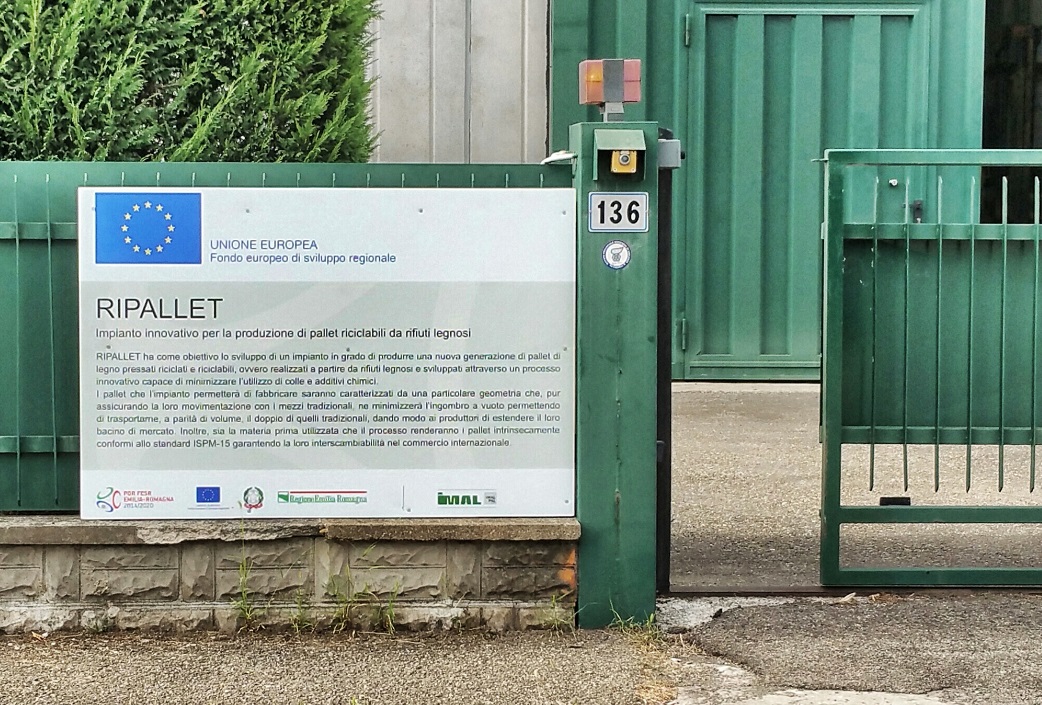
The company’s industrial strategy is to identify a first “pilot-customer” to enable the construction of an industrial scale plant for launching the new RI-PALLET product on the market immediately. In this way the product could be publicised on the market and a new business model could be promoted characterised by an elite number of highly automated production facilities, which will reach out to a much wider market with respect to that served by today’s small scale manufacturers.